

Phone makers love a big number, and mAh is the easiest big number to put on a box. A 6,000 mAh battery sounds twice as good as a 3,000 mAh one. In practice it often is not, and sometimes it is not even close. This guide explains what mAh really measures, why it does not tell you the whole story and how to use it sensibly when you buy a phone or a replacement battery.
What mAh actually measures
The unit mAh stands for milliamp-hours. It describes how much electric charge a battery can supply: a 3,000 mAh battery can, in principle, supply 3,000 milliamps for one hour, or 300 milliamps for ten hours. It is a measure of charge, not of energy. To know how much energy that is, you also need the voltage, because energy is charge times voltage. The page on the ampere-hour explains the unit in more detail.
That is why two batteries with the same mAh can hold different amounts of energy if their voltages differ, and why watt-hours, which include voltage, are a fairer number for comparison. Laptop batteries are usually labelled in watt-hours for exactly this reason. Our guide on how to check laptop battery health shows that capacity measure in practice.
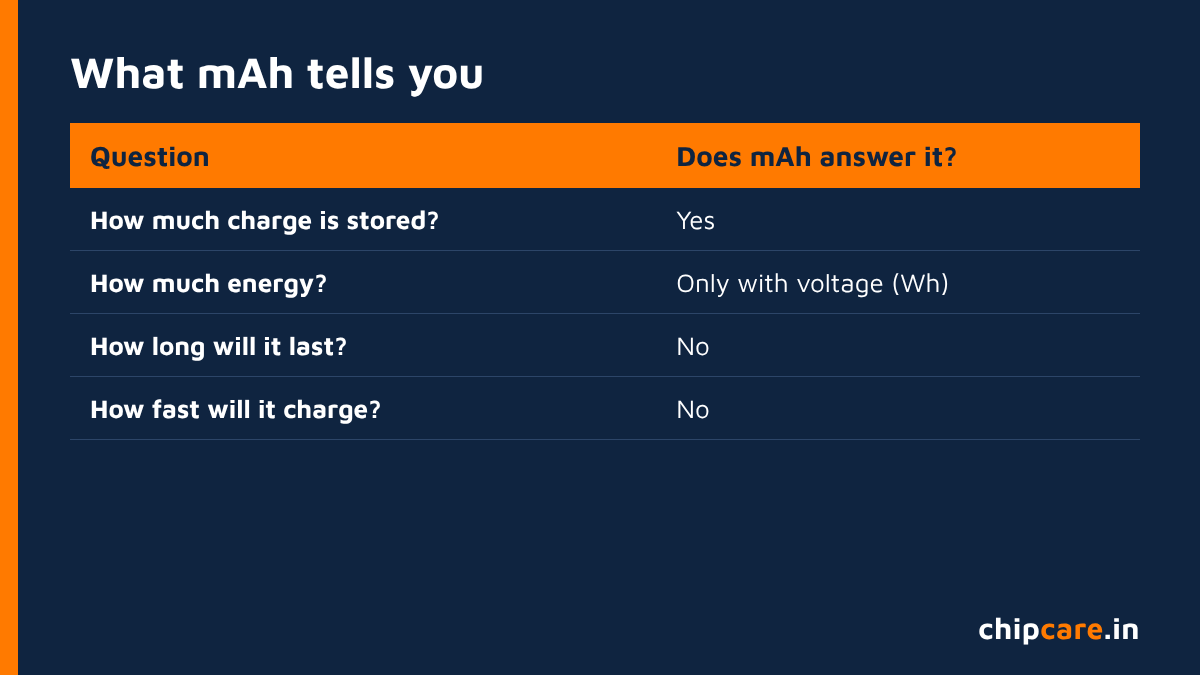
What mAh does and does not tell you
| Question | Does mAh answer it? | What actually decides it |
|---|---|---|
| How much charge can the battery hold? | Yes | Cell size and chemistry |
| How much energy is stored? | Only with voltage | Watt-hours |
| How long will the phone last? | No | Screen, processor, software, signal, habits |
| How fast will it charge? | No | Charger, cable, charging system and heat |
| How long will it stay healthy? | No | Quality, heat, charging habits |
A bigger battery is not always better. A well-optimised phone with a smaller battery can outlast a power-hungry one with more mAh.
Why the same mAh gives different battery life
Battery life is a balance between supply and demand. mAh is the supply. The demand comes from the screen, the processor, the radios and the software. A phone with a bright, high-refresh OLED screen and a powerful chip uses more energy than a phone with a modest LCD and an efficient chip. Two phones with the same 5,000 mAh can last very different times. Software matters too. A phone that manages background tasks well wastes less. For a hands-on look at what drains yours, see why a phone battery drains fast.
Physical limits: why huge claims are suspicious
A battery cell stores a fixed amount of energy per unit of volume, and that amount has improved slowly over the years. If a replacement battery in the same size as your original claims much more capacity, it is almost certainly overstated. Real cells cannot beat the energy density of the technology. The page on lithium-ion batteries explains the chemistry and its limits.
- A replacement with 10 to 20 percent more capacity than the original, in the same size, deserves questions.
- A replacement with double the capacity is almost certainly mislabelled.
- A label with a very round, very large number and no brand is a warning sign.
- A battery that is noticeably lighter than the original often has a smaller cell than the label says.
If you want to learn how to spot a mislabelled cell, our guide on how to spot a fake mobile battery lists the tests, and it matters because a fake cell can be unsafe as well as disappointing.
Rated capacity versus typical capacity
Many batteries show two numbers: a rated capacity and a typical capacity. The typical value is the average measured in the factory. The rated value is slightly lower and is the minimum the maker promises. Both are small differences. They do not explain a battery that claims far more than the original, so do not let the existence of two numbers become an excuse for a doubtful label.
How mAh affects a replacement choice
- Find the original rating.
Look at the old battery's label or the phone's specification for the original capacity. - Match it closely.
A replacement within a small margin of the original is realistic. - Prefer the right model code.
Fit and connector matter more than the headline number. See how to find the right phone battery model number. - Check the warranty.
A seller who is confident about the capacity will back it in writing. - Test it after fitting.
Watch how the phone behaves over a few days rather than trusting the label.
Rule of thumb: choose the battery that matches your model code and carries a real warranty. Then treat any capacity above the original as a claim to question, not a bonus.
Battery health and capacity over time
Every battery loses capacity as it ages, so a 5,000 mAh battery will not hold 5,000 mAh forever. After a couple of years of daily use, it may hold noticeably less. That is why battery life falls, and why a replacement helps. Our guide on how to check phone battery health shows how to see where yours stands. Heat and fast charging speed up the loss, as explained in fast charging vs normal charging, and the long-life advice from Battery University is a useful reference.
Choosing a phone by battery
If you are buying a phone and care about battery life, mAh is a starting point, not the answer. Read independent battery tests when you can, because they measure real use. Look at the screen type and refresh rate, because they have a large effect. Consider the charging speed and the charger in the box. And remember that a phone with good software support will usually manage its battery better over time. A smaller battery in an efficient phone often beats a large one in a thirsty phone.
Need a replacement battery?
Match your model code and compare capacity, grade and warranty.
Frequently asked questions
What does mAh mean on a phone battery?
It stands for milliamp-hours and measures how much charge the battery can supply. It is a capacity figure, not a direct measure of battery life.
Does a higher mAh always mean longer battery life?
No. Battery life also depends on the screen, processor, software and how you use the phone. A smaller battery in an efficient phone can outlast a bigger one in a thirsty phone.
Why do replacement batteries sometimes claim more mAh than the original?
Often because the label is exaggerated. Real cells of the same size cannot hold much more than the original, so a large jump is a warning sign.
What is the difference between mAh and Wh?
mAh measures charge. Wh measures energy, because it includes voltage. Wh is a fairer way to compare batteries with different voltages.
How much mAh do I need?
It depends on how you use the phone. For most people, the original capacity for your model is right. Focus on a quality battery that matches it.
Does fast charging reduce mAh capacity?
Fast charging does not change the label, but heat from it can wear the battery faster over time, which reduces real capacity.