Buying a charger sounds simple until you stand in front of a wall of options with different watts, different plug shapes and claims about "super fast" charging. The wrong charger can make your phone charge slowly, run hot or, in the worst cases, damage the battery. The right one is cheap and lasts for years. This guide explains what the numbers mean, how to match a charger to your Android phone and what to check so that you do not end up with a poor-quality adapter.
Understand the numbers
A charger's power is measured in watts, which is volts multiplied by amps. A phone asks the charger for the power it can handle, and the charger supplies up to its maximum. A charger that is stronger than the phone needs is safe, because the phone takes only what it can use. A charger that is weaker simply charges more slowly. So you do not need the biggest charger, only one that matches your phone's fastest supported rate, with a little headroom. Check your phone's specifications for its maximum charging power, and look for chargers at or above that figure.
Protocol matters as well. Phones use charging protocols to agree on speed, and different brands support different ones, though many now support the common USB Power Delivery standard. A charger that supports your phone's protocol will reach full speed, and one that does not may charge at a slower default rate. Look for a charger that lists your phone's protocol or a broad range, and read reviews from users of the same phone.
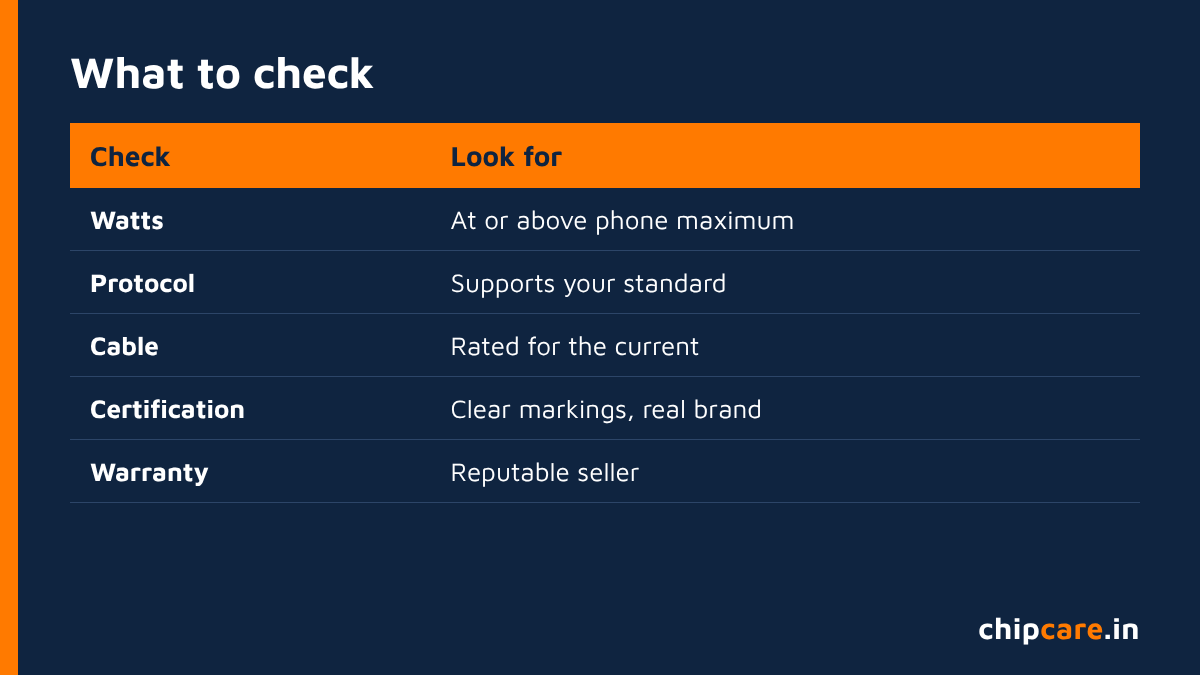
What to check
| Check | What to look for |
|---|---|
| Power in watts | At or slightly above your phone's maximum |
| Charging protocol | Supports your phone's fast-charging standard |
| Cable | Rated for the current, with proper connectors |
| Safety certification | Clear markings and approvals, with a proper brand name |
| Build quality | Solid casing, firm plug and no strange smell or rattle |
| Warranty and seller | A reputable seller who gives a warranty |
A charger is a mains-powered device. Saving a little on an unbranded one is the wrong place to economise.
Original, third-party or generic
The original charger is designed for your phone and is usually the safest choice, but a good third-party charger from a reputable brand can match it, often with the bonus of supporting several devices. Generic, unbranded chargers are the risk. They may lack proper protection against overheating and short circuits, they often exaggerate their power and they can damage the phone or become a fire hazard. Look at the markings on the casing for the brand, the model, the input and output ratings and safety marks. Blurry print, spelling mistakes and missing information are warning signs. If a charger feels very light for its claimed power, be suspicious.
Step by step: choosing a charger
- Find your phone's maximum charging power.
Check the specifications or the original charger's label. - Check the protocol.
Note whether the phone uses a brand protocol or a common standard. - Choose a charger at or above that power.
A little extra headroom is fine, and safe. - Choose a good cable.
A fast charger needs a cable rated for the current. A thin cable limits the speed. - Check the brand, markings and warranty.
Buy from a seller who gives a warranty and proper bill. - Test after buying.
Time a ten-minute charge, and feel for excessive heat.
Single, multi-port and travel chargers
If you charge one phone at a time, a single-port charger is enough. If you charge a phone, tablet and earbuds together, a multi-port charger saves sockets, but check the power split, because a four-port charger may share its total power between the ports. For travel, a compact charger that supports a wide input range is convenient. A car charger needs the same checks, and a poor one can damage the phone or the car's socket. See our power bank buying guide for portable options.
Check the sockets at home too. Loose sockets, damaged extension boards and unearthed plugs can cause chargers to run hot or give poor contact. Use good-quality wiring and avoid overloading a board.
Common mistakes
- Buying on watts alone and ignoring the protocol.
- Using a thin, cheap cable with a fast charger.
- Choosing an unbranded charger because it claims "extra fast".
- Assuming a more powerful charger will harm the phone. It will not, but a poor one might.
- Charging with a damaged cable or a cracked adapter.
If your charger seems faulty
Signs include slow charging, intermittent charging, a hot adapter, a buzzing noise or a burning smell. Stop using it and try another. If the new one works well, the old charger was at fault. If not, check the port and the battery. See fast charging not working, why a phone charges slowly and phone heating while charging. Do not open a charger, since the insides carry mains voltage.
For laptop charging, see how to choose a laptop charger. For background on the standard, see the page on USB Power Delivery.
Questions to ask the seller
- What is the maximum output, and which charging protocols does it support?
- Which phones has it been tested with?
- What safety certifications does it carry, and can I see the markings?
- What is the warranty, and what happens if it fails?
- Is the cable included, and what is its rating?
A knowledgeable seller will answer these confidently. If the answers are vague or the seller pushes a price instead of facts, look elsewhere. A charger plugs into the mains and sits next to your bed or desk for years, so it is worth buying from someone who stands behind it.
When you get the charger home, look it over. The casing should be solid, the plug should fit snugly in the socket, and the markings should be sharp and complete. Charge your phone and feel the adapter after a few minutes. It will be warm, which is normal, but it should not be too hot to touch. If anything seems wrong, stop using it and return it. A small amount of caution at the start avoids a bigger problem later.
Frequently asked questions
How many watts do I need in a phone charger?
Match your phone's maximum charging power, or go slightly above. A stronger charger is safe, because the phone takes only what it needs.
Can a more powerful charger damage my phone?
No, not a good one. The phone controls how much power it draws. The danger comes from poor-quality chargers.
Do I need the original charger?
No, but it is the safest. A reputable third-party charger that supports your phone's standard works well.
Does the cable matter?
Yes. A fast charger needs a cable rated for the current, and a cheap cable can limit the speed.
How can I spot a fake charger?
Look for blurry markings, missing certification, unusual weight, a very low price and unrealistic power claims.
Is it safe to use a multi-port charger?
Yes, if it is a good one. Check how the total power is shared between ports.